
Behavioural finance has an awkward problem: everybody can list the biases and almost nobody catches themselves having one.
That is not stupidity. A bias does not announce itself as a bias. It arrives dressed as a perfectly sensible thought, with reasons attached. "This fund has been underperforming for two years, it's time to move on" is not experienced as the disposition effect. It is experienced as prudence.
So this article is organised around what each one feels like, rather than what it is called. The collective cost of these is measurable, and we covered the size of it in the behaviour gap. This is the anatomy.
1. Loss aversion
What it feels like: "I'll sell once it gets back to what I paid."
Losing ₹1 lakh hurts roughly twice as much as gaining ₹1 lakh feels good. That asymmetry is one of the most reliably reproduced findings in the field, and it distorts everything downstream.
The specific damage is that it makes your purchase price feel meaningful. It is not. The market has no memory of what you paid, and "getting back to even" is a target with no relationship to whether the holding is worth keeping. People hold poor investments for years waiting for a number that exists only in their own records.
The catch: ask yourself — if I held cash today instead of this, would I buy it at today's price? If no, your purchase price is the only thing keeping you in.
2. Recency bias
What it feels like: "This category has done well for three years, it clearly works."
Recent events feel more representative of the future than distant ones. Three good years feel like a pattern; the fifteen years before them feel like history.
This is the engine behind almost every badly timed purchase. Money flows into whatever has just performed, which is to say it arrives after the returns rather than before them. It is also why every "top performers" list is a list of things that have already happened.
The catch: before buying anything on the strength of its record, look at a period at least three times longer than the one that impressed you. If the story only works over three years, it is not a story about the investment.
3. Anchoring
What it feels like: "The index was at 26,000 last month, so 24,000 is cheap."
The first number you encounter sets a reference point that later judgements attach themselves to, whether or not it means anything.
A recent high is the most common anchor in investing, and it carries no information about value. So is a round number, a purchase price, or whatever a colleague mentioned. "Down 20% from its peak" describes the past and says nothing about the future — but it reliably feels like a discount.
The catch: notice when your reasoning contains a comparison to a previous price rather than to anything about the underlying holding. That is an anchor doing the work.
4. Herding
What it feels like: "Everyone I know is in this. Am I missing something?"
Acting alone feels risky in a way that acting with a crowd does not, even when the crowd's reasoning is invisible to you.
The social pressure is real and it peaks at exactly the wrong time. Enthusiasm is loudest near tops and silence is deepest near bottoms, so herding systematically times your entries and exits badly. It also feels much better than being right early, which is one of the loneliest experiences in investing.
The catch: ask what the person recommending it actually knows that you do not. Usually the honest answer is "nothing — they heard it too."
5. Confirmation bias
What it feels like: "I've read a lot about this and everything supports it."
Once you hold a view, you notice supporting evidence and skate past contradicting evidence. You are not lying to yourself; the supporting material genuinely is more memorable and more satisfying to read.
This is worse now than it used to be. Search and feeds return what you engage with, so researching a decision you have already made produces a wall of agreement that feels like diligence.
The catch: deliberately look for the strongest argument against what you are about to do, and see whether you can state it fairly. If you cannot state it well, you have not understood the decision.
6. Mental accounting
What it feels like: "This is bonus money, so I can take more risk with it."
Money gets sorted into categories with different rules attached — salary is serious, a bonus is free, an inheritance is special, winnings are house money.
It is all the same money and it all buys the same things. The most expensive version of this in India is running a fixed deposit at 7% while carrying a credit card balance at 40%, because the deposit is "savings" and the card is "a bill". The arithmetic is unambiguous and the mental filing keeps it invisible.
The catch: once a year, list every asset and every liability on a single page. Categories dissolve when everything is on the same sheet.
7. Overconfidence
What it feels like: "I'm fairly good at this. I'd have held through 2020."
Most people rate themselves above average at investing, which is arithmetically impossible in aggregate. More to the point, most people who sold in a previous crash also believed beforehand that they would not.
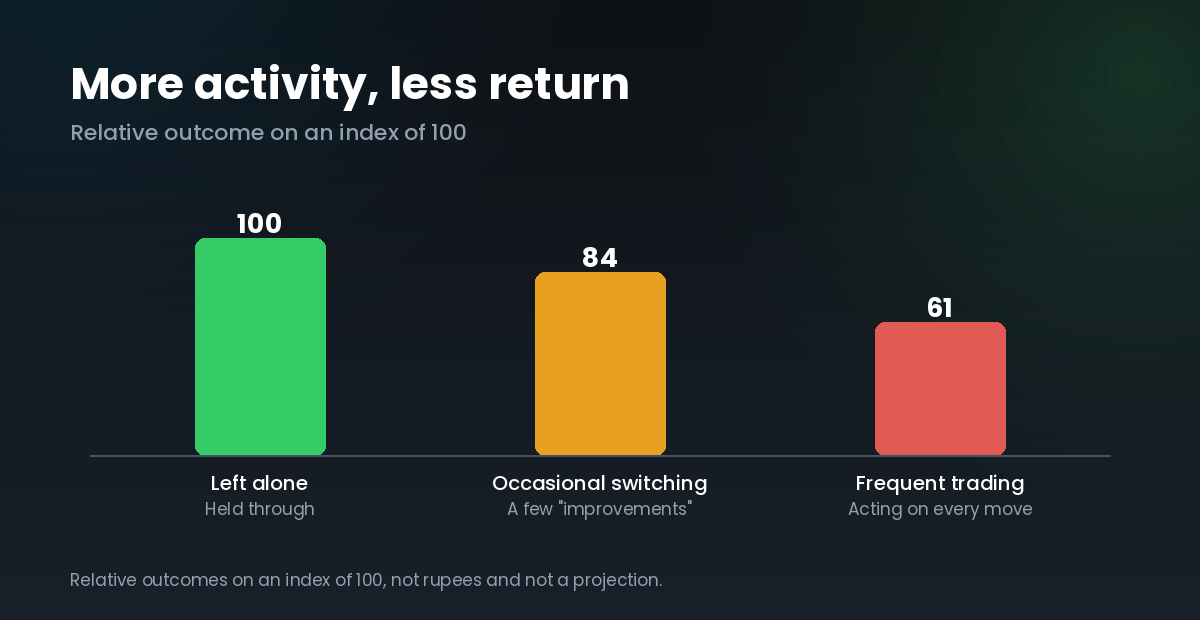
Overconfidence has a specific signature: it increases activity. More trades, more switches, more confidence about timing. And activity correlates negatively with returns, because each action is an opportunity to be wrong plus a cost.
The catch: the only real evidence about your temperament is what you did last time. If you held through a fall of 30% or more, with money that mattered to you, you know something. If you have never been tested, you have a hypothesis.
The bias about biases
There is one more, and it undermines everything above.
Having read this, you will find it easy to spot these in other people and hard to spot in yourself. That gap has a name — the bias blind spot — and it is why articles like this change less behaviour than they should.
Which leads to the only conclusion that survives contact with reality: you will not think your way out of this in the moment. The moment is precisely when it does not work.
What actually helps
Structure, decided in advance, when nothing is happening.
- Automate contributions. A SIP with a standing mandate removes the monthly decision entirely, and a decision not made cannot be biased.
- Write down your reasons at the time of buying — including what would make you sell. When the moment comes, you are reading a calmer person's decision rather than making a fresh one under stress.
- Rebalance on a date, not a feeling. An annual calendar rebalance mechanically sells what has risen and buys what has fallen, which is the correct action and the one you will never take voluntarily.
- Reduce how often you look. Checking daily shows a loss about half the time; checking yearly, far less. Frequent observation increases the pain without improving a single decision.
- Have a second opinion available — someone whose own money is not moving, to talk to for twenty minutes in week three of a bad drawdown.
None of that requires you to be less human. It requires you to accept that you are, and to build accordingly. The investor who assumes they will panic and automates around it consistently ends up ahead of the one who is confident they will not.