
Mutual fund taxation in India is not complicated, but it is fragmented. The rules depend on what the fund holds, how long you held it, and — for debt funds — when you bought it. Miss one of those and you get the wrong answer.
This covers the position as at August 2026. Capital gains rules were substantially rewritten in the July 2024 Budget and have not materially changed since, but tax rules do change, so check the date on anything you read about tax, including this.
First: you are only taxed when you sell
This trips up more people than anything else. Your fund going up does not create a tax liability. Growth in NAV is unrealised, and unrealised gains are not taxed.
Tax arises when you redeem units, or when you switch between schemes — and a switch is the one people forget. Moving from one scheme to another is a redemption followed by a fresh purchase. It is a taxable event even though no money reached your bank account. The same applies to moving from a regular plan to a direct plan of the same fund.
A Systematic Transfer Plan is a series of switches, so each instalment is a small redemption with its own holding period. An SWP is the same.
Equity funds
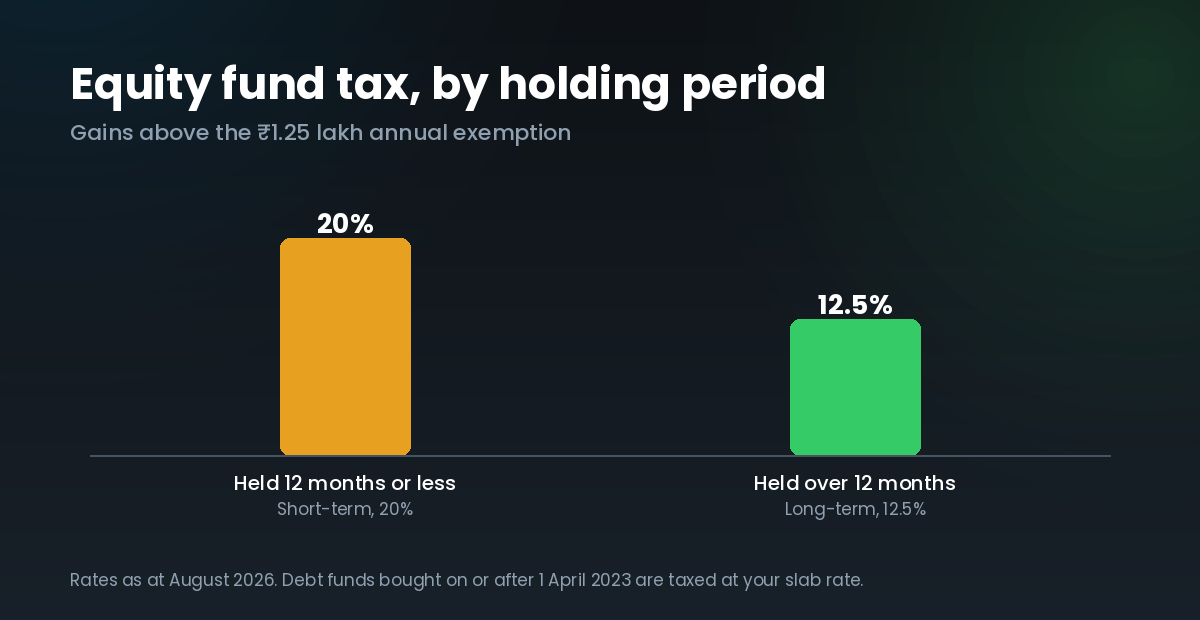
A fund counts as equity-oriented if it holds at least 65% in Indian equities. Most diversified equity funds, index funds tracking Indian indices, ELSS and equity-heavy hybrids fall here.
| Holding period | Classification | Rate |
|---|---|---|
| 12 months or less | Short-term (STCG) | 20% |
| More than 12 months | Long-term (LTCG) | 12.5% |
The important detail: the first ₹1.25 lakh of long-term capital gains in a financial year is exempt. That exemption is combined across all your listed shares and equity mutual funds — it is not per fund and not per folio. Above ₹1.25 lakh, the excess is taxed at 12.5%.
Indexation is not available under the 12.5% regime. Surcharge and cess apply on top of these rates as they do to any tax.
What that means in practice
If you redeem units held for more than a year and the gain is ₹1.8 lakh, the first ₹1.25 lakh is exempt and you pay 12.5% on ₹55,000 — that is ₹6,875, before surcharge and cess. Note the tax is on the gain, not on the amount you withdraw. Redeeming ₹5 lakh where ₹4 lakh was your own capital produces a ₹1 lakh gain, not a ₹5 lakh one.
Debt funds — and the April 2023 line
This is where people are most often wrong, because the answer depends on when you bought.
Units purchased on or after 1 April 2023 in a specified mutual fund — broadly, one holding 35% or less in Indian equities — have all gains treated as short-term regardless of how long you hold them. They are added to your income and taxed at your slab rate. There is no long-term treatment and no indexation, however long you stay invested.
Units purchased before 1 April 2023 retain the older treatment: held for more than 24 months, gains are long-term and taxed at 12.5%.
So two people in the same debt fund can face entirely different tax outcomes based only on purchase date. If you hold debt funds bought either side of that line, your CAS will show the purchase dates and it is worth knowing which is which before you redeem anything.
The practical consequence: debt funds lost the tax advantage that used to make them clearly better than fixed deposits for higher-rate taxpayers. They still have merits — liquidity, no penalty for early exit, and you control the timing of the tax event, which an FD's annual interest accrual does not let you do. But the headline advantage is gone.
Hybrid funds: look through to the equity holding
Hybrids are taxed on what they hold, not on what they are called.
- 65% or more in Indian equity — taxed exactly like an equity fund. 12 months, 20% / 12.5%, ₹1.25 lakh exemption.
- 35% or less in Indian equity — taxed like a post-April-2023 debt fund. Slab rate, no long-term treatment.
- Between 35% and 65% — a middle category: long-term after 24 months, taxed at 12.5%.
Aggressive hybrids and balanced advantage funds are usually structured to stay above the 65% line, often using derivatives to do so while running lower real equity exposure. Conservative hybrids typically sit at the other end. The scheme information document states the equity allocation; the name does not reliably tell you.
Dividends, or IDCW
What used to be called the dividend option is now Income Distribution cum Capital Withdrawal, and the rename is honest — part of what you receive is your own capital returned to you.
Since April 2020, IDCW is added to your income and taxed at your slab rate. The AMC deducts TDS at 10% if your distributions from that fund house exceed ₹5,000 in a financial year.
For anyone in the 30% bracket this is usually the worst of the available options. A growth plan with an occasional planned redemption gives you the same cash flow taxed as capital gains — 12.5% on equity after a year, with the ₹1.25 lakh exemption — rather than at 30%. That is a general observation about the tax treatment, not a recommendation about your situation.
ELSS and the regime question
ELSS funds carry a three-year lock-in and qualify for deduction under Section 80C, up to ₹1.5 lakh a year.
But 80C is only available under the old tax regime, and the new regime is now the default. If you are on the new regime, an ELSS investment gives you no deduction at all — it is simply an equity fund with a three-year lock-in, which is strictly worse than the same fund without one.
Check which regime you are on before treating ELSS as a tax-saving instrument. A great many people did not, and locked money up for nothing.
On lock-in with SIPs: each instalment locks for three years from its own date. A SIP started in April 2026 has its final instalment freed in March 2032, not 2029.
Set-off and carry-forward
Losses are useful and routinely wasted.
- Short-term capital losses can be set off against both short-term and long-term gains.
- Long-term capital losses can only be set off against long-term gains.
- Unabsorbed losses carry forward for eight assessment years — but only if you filed your return by the due date. Miss the deadline and the carry-forward is lost.
That last point is worth repeating because it costs people real money for no reason other than a missed filing date.
Practical things that save trouble
- Get your CAS. A consolidated account statement from CAMS or KFintech shows every folio across every AMC, with purchase dates. It is free and it is the document that answers most tax questions.
- Check the ₹1.25 lakh headroom before you redeem. Splitting a large redemption across two financial years can use the exemption twice. This is arithmetic, not avoidance.
- Count the days. Redeeming an equity fund at 11 months and 20 days rather than waiting is the difference between 20% and 12.5% on the gain.
- Remember that a switch is a sale. Including regular-to-direct.
- NRIs face TDS at source on redemptions, at rates that differ from resident treatment, with relief available under the applicable double taxation treaty. If that is you, take advice specific to your country of residence.
Where this stops
We are a mutual fund distributor, not tax advisers, and your position depends on your total income, your regime, your other gains and losses, and things this article cannot know. Nothing here is advice on your specific circumstances. For anything material — a large redemption, an estate matter, NRI status, business income — speak to a chartered accountant. It is a small cost against the size of the mistakes available.