
A SIP is not a product. That is the first thing to get straight, because half the confusion around this comes from people thinking they are buying a thing called a SIP.
A Systematic Investment Plan is an instruction: take a fixed amount from my bank account on a fixed date and buy units in this scheme. That is all. The investment is the mutual fund scheme. The SIP is the standing order that feeds it.
Which matters, because choosing badly and then automating it means you now make the same mistake every month without thinking about it.
Before the paperwork: three questions
1. What is the money for, and when do you need it?
Not "wealth creation". A date and a number. A car in four years is a different problem from retirement in twenty-five, and the same scheme cannot be right for both.
The horizon does most of the work in deciding what you should hold. Money needed within about three years has no business being in equity, because the range of outcomes over three years is far too wide to plan around. Money you will not touch for fifteen years can absorb volatility that would be reckless over three.
If you cannot answer this question, that is worth knowing before you automate anything.
2. Is your emergency fund in place?
Four to six months of expenses, in something you can reach within a day. Not in equity.
The reason is mechanical rather than moral. Without a buffer, the first medical bill or job gap forces you to redeem — and emergencies are uncorrelated with markets, which means you will sometimes be selling into a fall. That converts a temporary decline into a permanent loss, and it is the single most avoidable way people damage a portfolio.
A SIP started before the buffer exists is usually a SIP that gets stopped.
3. Are you carrying expensive debt?
Credit card debt in India runs at roughly 36–42% a year. There is no investment that reliably beats that, and clearing it produces a certain saving equal to that interest rate, with no market risk attached. Clear it first. Personal loans at 14–18% deserve the same treatment.
A home loan is a different case — the rate is far lower and there may be tax relief — so running a SIP alongside a home loan is usually reasonable.
The mechanics
Step 1: complete your KYC
KYC is a one-time process across the whole mutual fund industry. Once done, it works with every AMC.
You need PAN, Aadhaar, a bank account in your own name, a photograph and a signature. It can be completed online through any AMC, an RTA like CAMS or KFintech, or through a distributor. Video KYC typically completes in a day or two.
If you have invested before, you may already be KYC compliant — check your status on the CAMS or KFintech site before redoing it. Also check whether your status reads "KYC Validated"; some older records need re-verification before you can transact with a new fund house.
Step 2: decide the amount
Pick a number you can sustain through a bad year, not the maximum you can manage in a good month.
A SIP that runs for fifteen years at ₹10,000 does far more than one that starts at ₹25,000 and stops in month fourteen because it was always uncomfortable. You can increase it whenever you like — most platforms support a step-up instruction that raises it automatically each year, which is the easiest way to keep pace with your income without having to remember.
Starting small is not a failure of ambition. Consistency is the entire mechanism.
Step 3: choose the scheme
We are a distributor and we are not going to name schemes here — AMFI's guidance is clear that distributors should not make scheme-specific recommendations to people whose circumstances they do not know, and we agree with the reasoning. What we can set out is what to look at:
- Category before fund. The decision that matters is what kind of fund — equity, debt, hybrid, and what sort within that. Fund choice within a category matters far less than most marketing implies.
- Expense ratio. Published on every AMC's site, for both plan versions. It compounds against you.
- Whether you understand what it holds. If you cannot describe the strategy in a sentence, you will not hold it through a fall.
- Not last year's returns. Chasing recent performance is the most reliably documented way retail investors underperform the funds they own.
Step 4: pick a date, and stop worrying about it
People agonise over the SIP date. It does not matter. Studies comparing SIP dates across long periods find the differences are noise.
What does matter: set it two or three days after your salary credit. Money that sits in the account waiting gets spent. And ensure the balance is there — a bounced SIP can attract a bank penalty and, repeated, may cause the mandate to be cancelled.
Step 5: set the mandate
You will register an auto-debit — usually eNACH, authorised online with net banking or a debit card. Register it for a limit comfortably above your current instalment so that stepping up later does not require a fresh mandate.
Step 6: nomination
Do it now, at the point of investment, when it takes thirty seconds. Without a nomination your family faces a succession process to claim the money — with it, a claim is straightforward. This is the single highest-value minute in the whole exercise and it is the one most often skipped.
The first two years
Here is what nobody warns you about: your SIP will probably look disappointing early on, and this is normal rather than a signal.
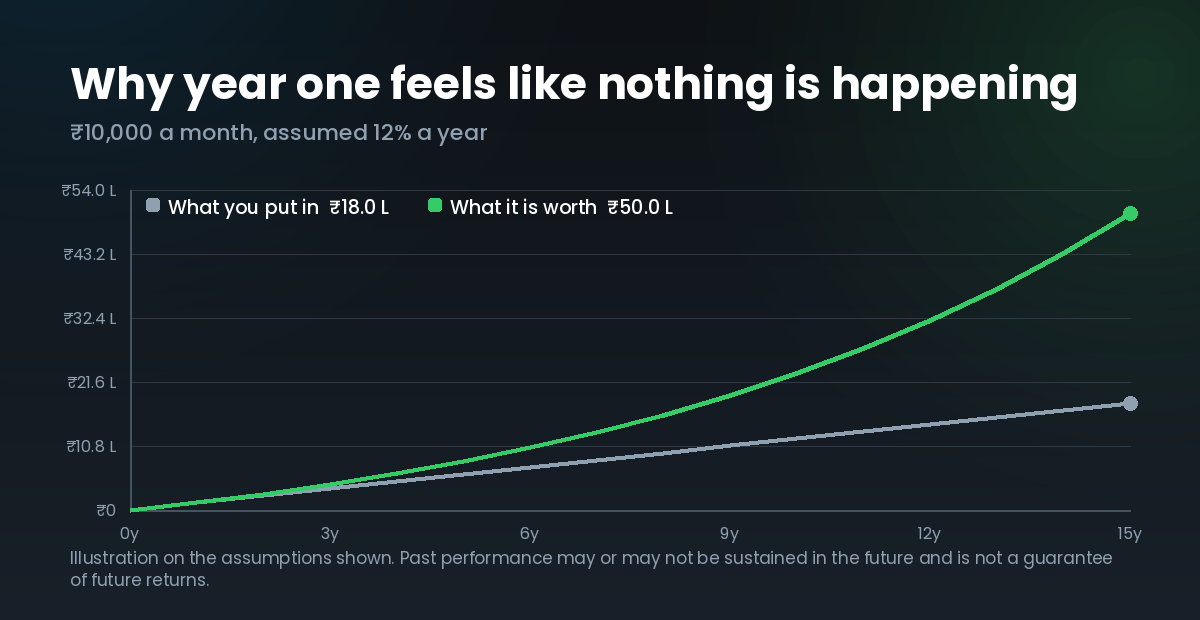
In year one, your contributions dominate. Returns act on a small balance, so the rupee movement is small either way. If markets fall in your first eighteen months, you may well be looking at less than you put in.
That is precisely when the mechanism is working best — the same instalment is buying more units at lower prices. The early years are when a SIP does its most useful work and feels like it is doing its least. Almost every investor who abandons the process does so here.
Compounding only becomes visible once returns are acting on a balance far larger than your annual contribution, which takes several years. Expecting it sooner is the main reason people quit.
Things to avoid
- Stopping during a fall. The one decision that reliably destroys the outcome. If you must reduce, reduce the amount — do not cancel.
- Starting six SIPs across six fund houses. You end up with overlapping holdings you cannot track and a statement you will not read.
- Checking daily. Frequent monitoring increases the chance of acting on noise. Quarterly is ample.
- Waiting for a better entry point. The waiting costs more than the timing saves. This is the most expensive form of caution there is.
A reasonable order
- Emergency fund — four to six months, liquid
- Expensive debt cleared
- Term insurance if anyone depends on your income, and health cover
- Then the SIP, matched to a specific goal and horizon
Most people invert this and start with the SIP because it feels like progress. The first three items are what stop the fourth from being interrupted.
If you would like the horizon and allocation part worked out before you commit to anything, our risk profiler takes about three minutes and gives you a starting point you can act on yourself or bring to a conversation.