
Not every conversation should end in an investment. Sometimes the honest answer is: not yet, and here is what to do first.
That is an awkward thing for a distributor to say, since we are paid when you invest and not when you do not. But the alternative — starting a SIP that gets abandoned inside two years — is worse for you and, in the end, worse for us.
The sequence
- Clear high-cost debt. Credit card balances in India run at roughly 36–42% a year; personal loans at 14–18%. Clearing them produces a certain saving equal to that interest rate, with no market risk attached. No investment reliably matches that.
- Build an emergency fund. Four to six months of expenses, in a savings account or a liquid fund. Boring, accessible, unglamorous.
- Get term insurance and health cover. If anyone depends on your income, this comes before investing. A portfolio is not a substitute for a policy, and it never becomes one fast enough.
- Then invest for specific goals.
Most people invert this, and start at step four because it is the one that feels like progress. Steps one to three are what stop step four from being interrupted.
Why the emergency fund matters so much
Not because of what it earns. A liquid fund will not build wealth and is not trying to. It matters because of what it prevents.
Without a buffer, the first real emergency forces you to redeem investments. And that redemption tends to happen at the worst possible moment, because the events that cause emergencies cluster with bad economic conditions. Job losses arrive in the same months as market falls. That is not bad luck; it is the same underlying cause showing up in two places.
So you sell equity at a low, possibly pay an exit load, possibly pay tax on whatever gain remains — and worst of all, you learn that investing is unreliable. Many people never come back after that, and the cost of not coming back dwarfs the cost of the redemption itself.
An emergency fund is not an investment. It is what lets your investments be left alone.
How much, exactly
Four to six months is the usual guidance and it is a starting point, not an answer. What actually drives the number is how quickly you could replace your income:
- Stable salaried job, two earners in the household — three to four months is defensible.
- Single income supporting a family — six months, and closer to six than four.
- Business income, commission, or freelance — nine to twelve months. Your income can fall to zero for a quarter without anything unusual happening.
- A specialised role where the next job takes months to find — size it to a realistic search, not an optimistic one.
Base it on expenses, not income — what you must spend, including EMIs, rent, school fees, insurance premiums and groceries. Not what you currently spend including holidays and restaurants. In a genuine emergency the discretionary half of your spending disappears immediately.
Where to keep it
Two properties matter and only two: you can reach it within a day, and its value does not move.
A savings account satisfies both, and the fact that it earns little is not the point. A liquid fund typically earns somewhat more with same-day or next-day redemption, and many AMCs offer an instant redemption facility up to a limit per day. Splitting between the two is reasonable — a portion in savings for immediate access, the rest in a liquid fund.
What it should not be in: equity of any kind, an ELSS with a three-year lock-in, a fixed deposit with a heavy penalty for premature withdrawal, or anything you would feel clever about. This money has one job and cleverness is not part of it.
The objection we hear most
"But I'm losing to inflation keeping money in savings."
Yes. You are. That is the cost of the option to not sell your equity at the bottom, and it is a very reasonable price.
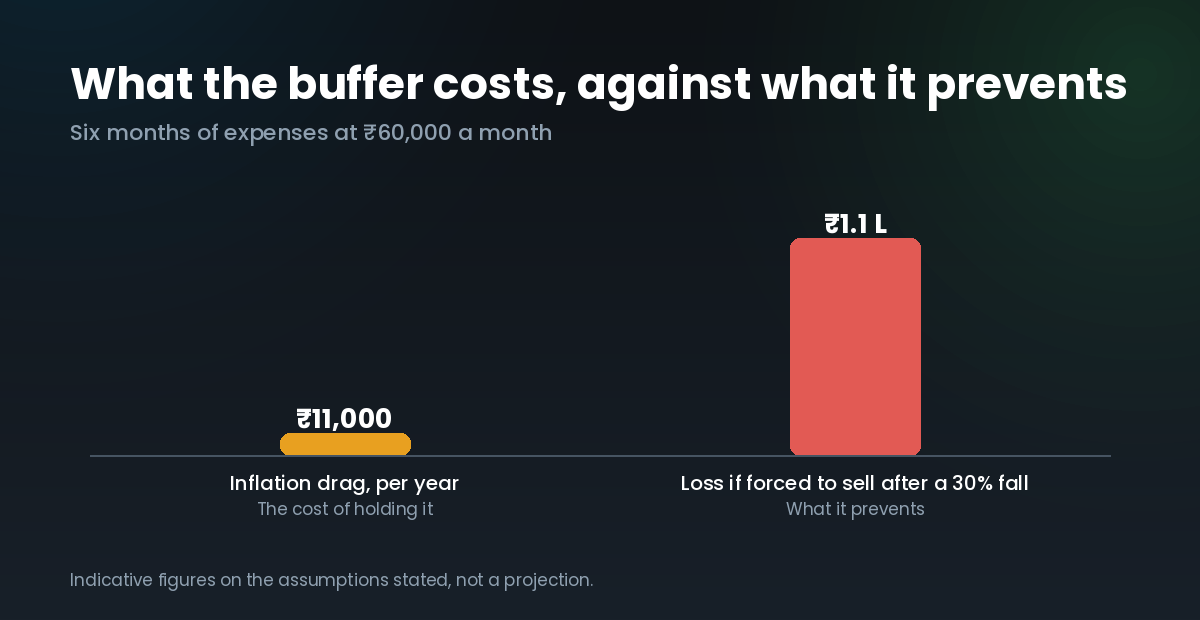
Put a number on it. Six months of expenses at ₹60,000 a month is ₹3.6 lakh. Losing, say, 3% a year in real terms costs roughly ₹11,000 a year. Now compare that with being forced to redeem ₹3.6 lakh of equity after a 30% fall, crystallising a loss of over ₹1 lakh, and quite possibly abandoning the whole exercise afterwards.
You are not losing money to inflation. You are buying insurance, and it is cheap.
The other objection
"I have a credit card with a high limit — that's my emergency fund."
A credit limit is borrowing capacity, not savings. It converts an emergency into 40% debt, which is how the sequence at the top of this page gets reversed. It is also the facility most likely to be withdrawn precisely when your circumstances deteriorate, which is when you would need it.
What this looks like in practice
If you have ₹30,000 a month to allocate and no buffer at all, we would typically suggest something like: ₹25,000 towards building the emergency fund until it is complete, ₹5,000 into a SIP.
The small SIP is deliberate and it is not about the money. It is about starting the habit, seeing the mechanics work, and having something in place when the buffer is finished — so the transition is an increase rather than a fresh start. Beginning from zero after eight months of saving is much harder than raising an amount that already exists.
Once the buffer is complete, the ₹25,000 redirects to investing and you are running a ₹30,000 SIP with a foundation under it.
One exception
If your employer offers a matched contribution — an EPF top-up or an NPS contribution that they match — take it even while you are building the buffer. A match is an immediate uplift you do not get back if you skip it, and it outweighs the general rule.
The point
The order matters more than the products. Someone with six months of expenses in a savings account and a modest SIP is in a stronger position than someone with an impressive portfolio, no buffer, and a credit card balance.
The second person looks like they are doing better. They are one hospital admission away from unwinding all of it.
If you want the sequencing worked out against your own numbers, our risk profiler asks about horizon and surplus before it says anything about allocation — and if the answer is "buffer first", it will say so.