
Ask ten people and you will get one answer: SIP is better because it averages your cost. That is the received wisdom, and it is mostly wrong — or at least, right for entirely the wrong reason.
The honest version is more uncomfortable, and more useful.
What the arithmetic actually says
Markets rise more often than they fall. That is not optimism, it is the base rate — equity markets spend most of their time above where they were a year earlier, punctuated by sharp falls.
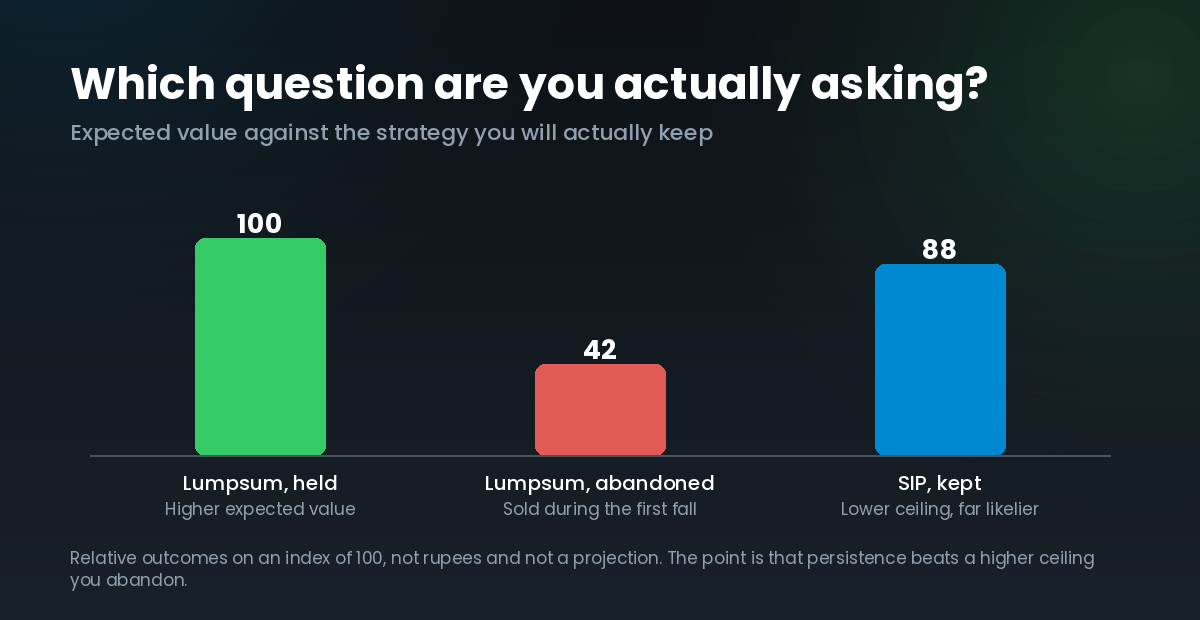
Which means: if you hold a lumpsum today and drip it into the market over twelve months, you spend most of that year holding cash while the market goes up without you. Studies across multiple markets and multiple decades consistently find that investing a lumpsum immediately beats phasing it in roughly two-thirds of the time.
So if the question is purely "which produces the higher expected value?", the answer is usually lumpsum, and it is not close.
The cost-averaging story people repeat has it backwards. Averaging your purchase price is only an advantage if prices fall after you start. If they rise — which is the more common case — averaging means paying more, not less. It is insurance, and like all insurance it has a price.
Why that is the wrong question
The right question is: which one will you actually stick with?
Deploying ₹20 lakh on a Monday and watching it become ₹17 lakh by Friday is an experience most people handle badly. They sell. They swear off equity. They sit in a fixed deposit for six years, and they tell the story at dinner parties for a decade. The theoretically superior strategy produced a materially worse outcome, because it was abandoned.
A SIP is not primarily a returns-optimisation tool. It is a behaviour-management tool. It removes the decision, removes the timing anxiety, and turns investing into something that happens whether or not you feel like it that month.
The comparison that matters is therefore not "lumpsum versus SIP" in a spreadsheet. It is "lumpsum you might abandon" versus "SIP you will probably keep". Run that comparison and the answer changes for a great many people.
The regret asymmetry
There is a psychological point here that the arithmetic misses entirely.
If you invest a lumpsum and the market falls 20% next month, you feel you did something. You made a decision, at a moment, and it was wrong. That is an active regret and it is sharp.
If you were running a SIP through the same fall, you feel considerably less. Nothing was decided; the instalments simply continued. The loss is identical in rupees and entirely different in how it lands.
People systematically underestimate how much this matters until they have lived through it. Active regret is what makes people sell. If phasing your money in is what stops you from panicking, then phasing is the better strategy for you, even though it has a lower expected value. Paying a small premium for a strategy you will not abandon is rational, not weak.
How we would actually decide
Most of the time this is not a real dilemma, because most people do not have a choice to make.
- A regular monthly surplus from salary. SIP. There is no lumpsum to deploy — the question does not arise. This describes most people asking it.
- A windfall, bonus or maturity proceeds, and a horizon beyond ten years. Deploy it into a sensible allocation, or phase it over three to six months if that is what lets you sleep. Twelve months is usually too slow; you spend most of the period in cash for a diminishing behavioural benefit.
- A lumpsum needed within three years. Neither. Money with a short horizon does not belong in equity at all, and the SIP-versus-lumpsum question is a distraction from the real error.
- A lumpsum, a long horizon, and no experience of a market fall. Phase it. You are making a bet on your own temperament with no evidence, and the phasing is what buys you the evidence cheaply.
The middle route people overlook
A Systematic Transfer Plan does what most people actually want. You park the lumpsum in a low-volatility scheme and transfer a fixed amount into equity on a schedule.
The money is invested from day one rather than sitting in a savings account, and it enters equity gradually. It gets you most of the behavioural benefit of a SIP without the full opportunity cost of holding cash.
One thing to be aware of: each transfer is a redemption from the source scheme, so each instalment is a taxable event. It is usually small, but it exists, and it surprises people who thought they had not sold anything. Our article on how mutual funds are taxed covers why a switch counts as a sale.
Three things that are not arguments
"I'll wait for a correction and then invest the lumpsum." This is market timing with extra steps. The correction may come after a further 30% rise, at which point your entry is worse than if you had simply invested. Waiting has a cost and it is invisible, which is exactly why people ignore it.
"SIPs give better returns." They do not, inherently. A SIP is a schedule of purchases. It produces a different average cost, which may be higher or lower. What SIPs reliably improve is persistence, and persistence improves outcomes — but that is a different claim, and worth stating precisely.
"I'll do a lumpsum because the market is low." Nobody knows the market is low. They know it is lower than it was, which is a statement about the past. If you find that distinction pedantic, that is a reason to phase your money in.
What actually decides the outcome
Neither choice matters as much as three others: how much you invest, for how long, and whether you keep going through the bad years.
Someone who invests a lumpsum at a bad moment and holds for twenty years will comfortably out-perform someone who times their entry perfectly and stops after four. The entry decision is a rounding error against the duration decision, and almost all the attention goes to the wrong one.
So: if you have a monthly surplus, start a SIP and stop reading about this. If you have a lumpsum and a long horizon, invest it, or phase it over a few months if that is the difference between doing it and not. Then leave it alone.
If you would like the horizon and allocation worked out before you commit either way, our risk profiler takes about three minutes.
All figures and scenarios above are illustrative. Mutual fund investments are subject to market risks and no return is assured.