
There are two return figures for every mutual fund and only one of them gets printed on the fact sheet.
The first is the fund's return: what a unit was worth at the start of the period, what it was worth at the end. It assumes you bought on day one and held throughout.
The second is the investor's return: what the people who actually owned it earned, weighted by when their money was in. Because money flows in after good years and out after bad ones, these two numbers are not the same.
The gap between them has a name, and it is consistently negative.
How large is it?
Studies of investor returns versus fund returns have been run across many markets over several decades, and they land in a similar place: a shortfall of roughly one to two percentage points a year, attributable to nothing but the timing of purchases and redemptions.
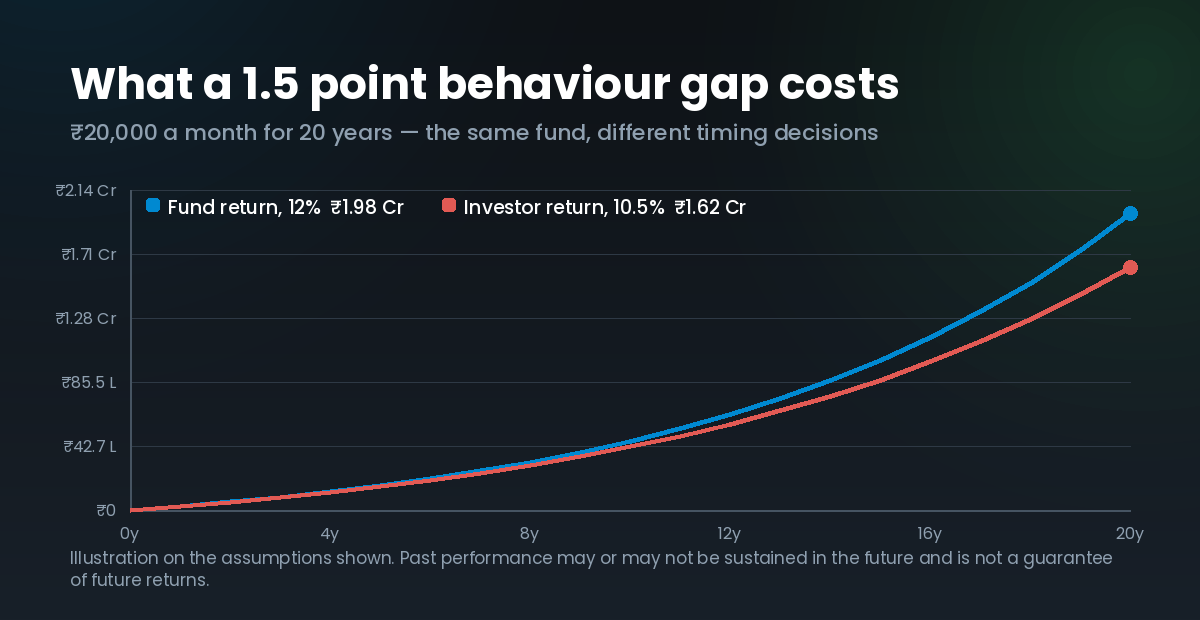
To see what that costs, hold everything else constant. ₹20,000 a month for 20 years at an assumed 12% compounds to roughly ₹1.99 crore. The same schedule at 10.5% — the same fund, with a one-and-a-half point behaviour gap applied — gives roughly ₹1.68 crore.
Around ₹31 lakh, lost to nothing except the decisions about when to be invested.
Notice that this is larger than the entire difference between a direct and a regular plan, which is the cost people spend far more time worrying about. We wrote about that comparison separately in direct or regular plan, and the honest conclusion there depends on exactly this: cost is certain, behaviour is not.
These are illustrations at assumed rates, not forecasts. Actual returns will differ and no return is assured.
Where the gap actually comes from
Buying what has just done well
Money flows into categories after they have performed. It is not irrational — recent performance is the most visible information available, and it is what every "top funds" list is built from.
The problem is that categories are cyclical. A fund that has run hard for three years has, by definition, become more expensive relative to its underlying holdings. Buying then means buying after the returns rather than before them. Repeat this a few times across a career and it accounts for a substantial part of the gap on its own.
Selling during falls
This is the expensive one. A 30% decline is uncomfortable in a way that reading about a 30% decline is not. Redeeming converts a temporary, recoverable fall into a permanent, realised loss — and then adds a second cost, because people who sell rarely re-enter at the bottom. They re-enter after the recovery is visible, which is to say after they have missed it.
The pattern is almost mechanical: sell near the low, buy back near the previous high, and pay for the entire round trip.
Switching
Portfolios accumulate switches. Something underperforms for eighteen months, something else looks better, the money moves. Each move feels like management.
Each one is also a redemption and a fresh purchase — a taxable event, potentially an exit load, and a reset of your holding period. And the fund being sold is frequently sold near the bottom of its own cycle, because that is when underperformance is most visible.
Stopping a SIP
The quietest version and one of the most damaging. Nobody thinks of pausing a SIP as a decision; it feels like caution. But the instalments you skip are precisely the ones buying units at low prices. Pausing a SIP for eighteen months during a fall removes the cheapest units you would ever have bought.
Why knowing this does not fix it
Everything above is well documented and widely published. Investors keep doing it anyway, and it is worth being honest about why.
Loss feels worse than equivalent gain feels good — that asymmetry is one of the most robust findings in behavioural research. A 20% fall does not feel like the mirror image of a 20% rise; it feels considerably worse, and it demands action in a way that a rise does not.
Doing nothing feels like negligence. Watching a portfolio fall while taking no action is genuinely difficult, because every instinct says a competent person would respond. In most other areas of life that instinct is correct. In this one it is precisely wrong.
And the news is loudest at the worst moments. Coverage volume peaks at the bottom, which is when the case for selling sounds most compelling and is least true.
This is why the gap persists among people who could explain it to you in detail. Knowing the psychology does not switch it off.
What actually closes it
Not willpower. Structure.
- Automate the contributions. A SIP with a standing mandate removes a monthly decision. Decisions made in advance, in calm conditions, are better than decisions made monthly under whatever conditions prevail.
- Write down why you own each holding, and what would make you sell it. Do it when you buy. When the moment comes, you are reading a decision made by a calmer version of yourself rather than making a fresh one.
- Match money to horizons. Most panic selling happens because money that was needed in two years was invested as though it had ten. Get the horizon right and half the behavioural problem disappears, because you are never forced to sell at a bad time.
- Look less often. The more frequently you check, the more often you see a loss — daily observation shows a fall roughly half the time, annual observation far less. Frequent checking increases the felt pain without improving any decision. Quarterly is ample.
- Rebalance on a calendar, not on a feeling. Once a year, on a date you set in advance, back to your target allocation. This mechanically sells what has risen and buys what has fallen, which is what you want and what you will not do voluntarily.
- Have someone to phone. Not for a fund recommendation. For the twenty minutes in week three of a bad drawdown when you are about to do something you will regret for a decade.
The uncomfortable part
Almost everybody reading this believes they are in the group that holds. That belief is not evidence, and it is unusually badly calibrated — most people who sold in a previous crash also believed it beforehand.
The only real evidence is what you did last time. If you held through a fall of 30% or more, with meaningful money, for over a year, you know something about yourself that is worth more than any fund selection. If you have never been tested, you have a hypothesis.
Neither is a reason for shame. It is a reason to build the structure that works for the person you actually are rather than the one you would like to be. The investor who accepts they will panic, and automates accordingly, ends up ahead of the one who is confident they will not.