
Every article you will read on this costs you nothing to write and costs the writer nothing to be wrong about. This one is different, because we are a distributor. If you choose a direct plan you do not pay us. So read this knowing exactly where it comes from, and judge it on whether the arithmetic holds up.
What the two things actually are
Since January 2013, every mutual fund scheme in India exists in two versions. Same fund manager, same portfolio, same holdings, same everything — except the expense ratio.
The regular plan includes a distribution commission inside its expense ratio. That commission is paid by the asset management company to whoever brought you in. The direct plan has no commission built in, so its expense ratio is lower. You buy it yourself, from the AMC or through an execution-only platform.
The difference is typically somewhere between 0.5% and 1.0% a year on an equity scheme, and much less on debt. It is not deducted from your account as a visible fee. It is netted out of the scheme's NAV before you ever see a number, which is precisely why so few people notice it.
The number that matters
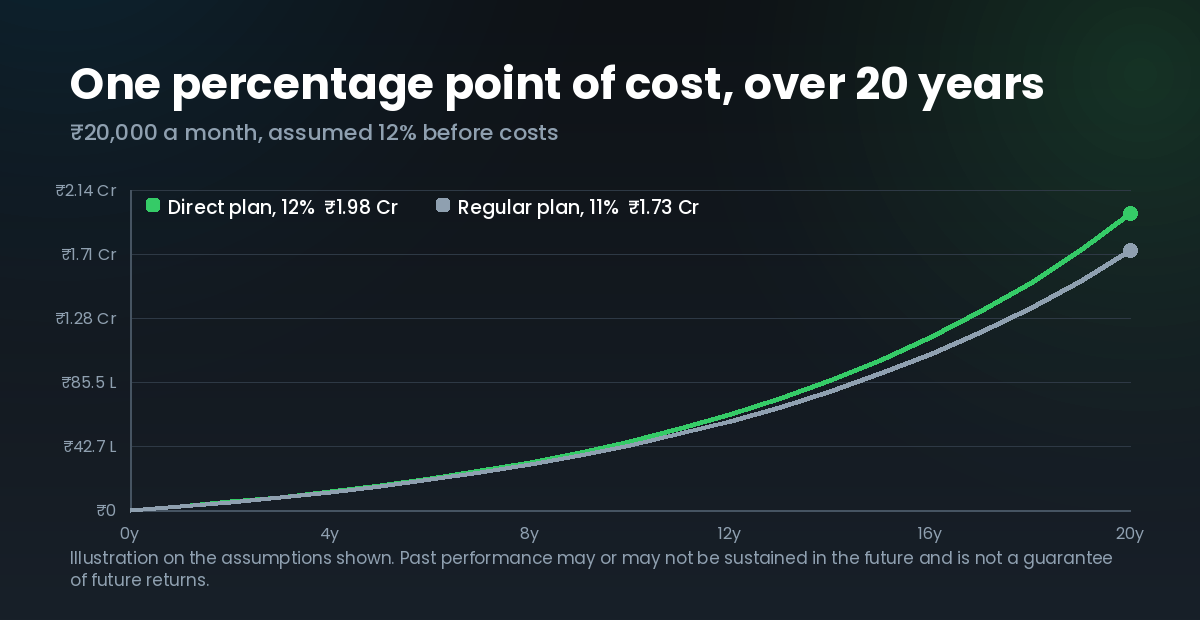
A percentage a year sounds trivial. Compounded over decades it is not. The honest way to see it is to hold everything else constant and change only the expense ratio.
Take ₹20,000 a month for 20 years. At an assumed 12% a year you would finish with roughly ₹1.99 crore. At 11% — the same fund, one percentage point of cost removed — you finish with about ₹1.75 crore.
That gap is around ₹24 lakh. It is not a rounding error and nobody should pretend it is. Anyone who tells you the cost difference is negligible is either not doing the sum or hoping you won't.
Those figures are illustrations at assumed rates, not forecasts. Actual returns will differ and no return is assured on any mutual fund scheme.
So why would anyone choose a regular plan?
Because ₹24 lakh is the cost of the distribution, and the relevant question is not "is the cost large?" It obviously is. The question is whether the alternative outcome — you, managing this alone for twenty years — leaves you better or worse off than that.
And here the evidence is genuinely uncomfortable for both sides of the argument.
The gap between what a fund returns and what its investors actually earn is well documented and consistently negative. Investors buy after good years and sell after bad ones. Studies of investor returns versus fund returns, across multiple markets and multiple decades, repeatedly find a shortfall of roughly one to two percentage points a year attributable to nothing but timing decisions.
That is the same order of magnitude as the entire cost difference we just calculated.
So the honest framing is this: the direct plan saves you a known amount. Whether you keep that saving depends on whether you behave better than the average investor over the next twenty years. Some people demonstrably do. Many people demonstrably do not. Most people believe they will, which is not the same thing.
When direct is the better choice
We will say this plainly because our own disclosures page commits us to it. Direct plans suit you if:
- You have already been through a serious drawdown without selling. Not a wobble — a 30% fall lasting more than a year, with your own money in it. If you held, you have evidence about yourself. If you have never been tested, you have a belief.
- You enjoy this. You read scheme documents, you rebalance because the calendar says so rather than because the market moved, and none of it feels like a chore. That is a real and uncommon trait.
- Your situation is simple. One or two goals, a steady salary, no business income, no property transactions, no complicated family arrangements.
- You will actually do the admin. Nomination updates, KYC renewals, bank mandate changes, consolidation of scattered folios. This is dull and it is the part that quietly goes wrong.
If those describe you, use a direct plan. You will keep the difference and you should.
When a distributor earns the difference
The value is not fund selection. We want to be blunt about that because the industry is not. Choosing among schemes is perhaps an hour of a relationship lasting decades, and it is the part most easily done with a screener.
What a distributor is actually for:
- Stopping you from stopping. The single most expensive thing an investor does is halt a SIP during a fall. It converts a temporary decline into a permanent one. Somebody phoning you in week three of a bad drawdown is worth more than any fund selection.
- Turning intentions into numbers. "I should save for my daughter's education" is not a plan. A monthly figure, a horizon and an allocation is.
- Noticing. A bounced SIP. A raise you should step up for. A folio still carrying your maiden name. A nomination never filed. These are small until the day they are enormous.
- Doing the paperwork so it stops being a reason to postpone.
If none of that is worth roughly 1% a year to you, then it isn't, and direct is the right answer. That is a legitimate conclusion and we would rather you reach it deliberately than drift into a regular plan without knowing what it costs.
Three things people get wrong
"Direct plans give higher returns." They give lower costs, which produces a higher net result from an identical portfolio. The fund has not performed better. Nothing about the underlying investment differs.
"I'll start with a distributor and switch to direct later." Switching means redeeming and repurchasing. That is a taxable event, and it may attract exit load. You can direct fresh money to direct plans at any time without touching what you hold — that is usually the sensible route if you change your mind.
"My distributor doesn't cost me anything, the AMC pays them." The AMC pays out of the scheme's expense ratio, and the expense ratio is borne by the scheme's investors. That is you. It is not an extra deduction from your bank account, but it is not free either, and any distributor who tells you it is has told you something untrue.
How to find out what you are paying
You do not have to take anyone's word for it.
- Pull your consolidated account statement from CAMS or KFintech. It is free and covers every scheme you hold.
- Check whether each scheme name carries the word "Direct". If it does not, it is a regular plan.
- Look up the scheme's total expense ratio on the AMC's website. Both plan versions are published side by side. The gap is what distribution costs you.
- AMFI publishes every AMC's commission disclosure monthly. It is public, and it is searchable.
We publish our own commission ranges on our disclosures page, because you should be able to see how we are paid without having to ask.
The point
Cost is certain and behaviour is not. That asymmetry is the whole argument, in both directions.
If you are confident you will hold through the next three bad years without flinching, take the certain saving. If you are honest enough to doubt it — and most people who have lived through one properly are — then the question becomes whether the person on the other end is worth what they cost. Ask them what they will actually do for you. If the answer is mostly about picking funds, you have your answer.