
Here is a pattern we see constantly. Someone starts a ₹10,000 SIP in their late twenties. Eight years later they are earning three times as much — and the SIP is still ₹10,000.
Their lifestyle absorbed the entire increase. Not through anything reckless; just gradually, invisibly, the way lifestyle inflation always works. A better flat. A car upgrade. Two more subscriptions. None of it felt like a decision, and collectively it consumed every rupee of eight years of raises.
What a step-up does
A step-up SIP raises your monthly investment by a fixed percentage every year — typically 10%, which is roughly a normal salary increment. Most platforms let you set it as a standing instruction when you start, so it happens without a decision each year.
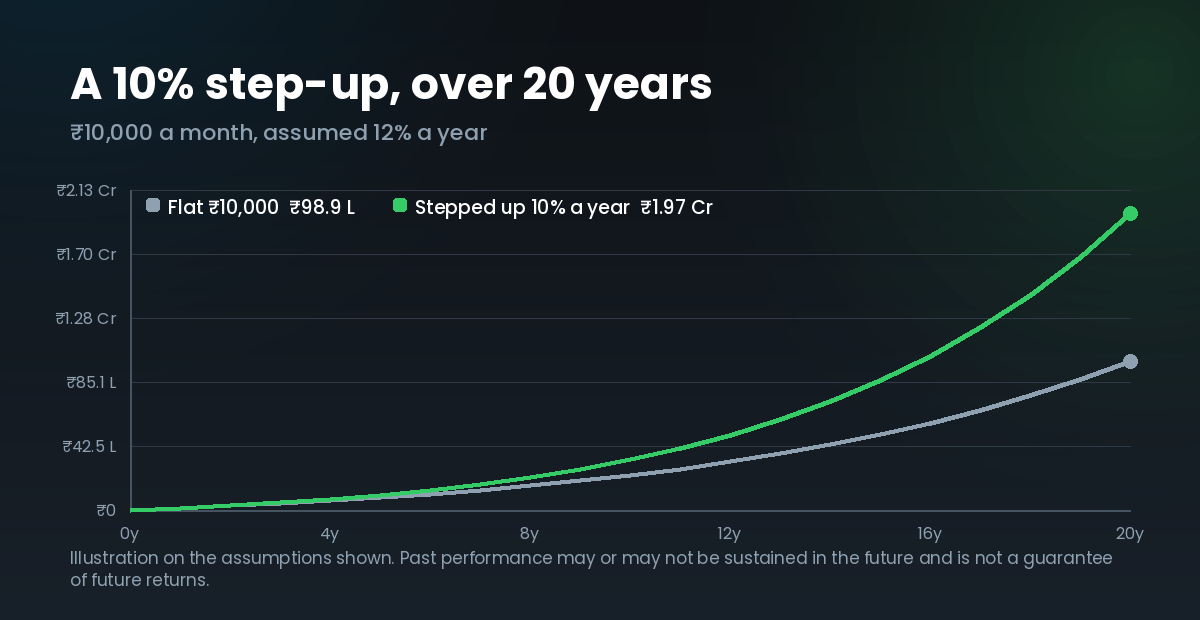
That is the entire mechanism. There is nothing clever about it, which is precisely why it is overlooked.
The size of the difference
Hold everything constant except the step-up and compare over 20 years at an assumed 12% a year.
| Flat ₹10,000/month | ₹10,000 stepped up 10% a year | |
|---|---|---|
| Total invested | ₹24.0 lakh | ₹68.7 lakh |
| Approximate final value | ₹99.9 lakh | ₹2.30 crore |
Roughly 2.3 times the outcome. And note where it comes from: you invested more, and the extra contributions still had years of compounding behind them.
The part that matters is that the additional money came out of raises you had not received yet. Your take-home never fell. At no point in those twenty years did you feel poorer than the year before — which is the whole reason this works when "just save more" does not.
Illustration at an assumed rate, for planning purposes only. Not a forecast. Actual returns will differ and no return is assured.
Why it works when willpower does not
The money is invisible. Raising your SIP in the same month your increment lands means you never experience a reduction. There is no sacrifice to feel, and therefore nothing to resent or reverse. Compare that with deciding, mid-year, to cut ₹5,000 a month from your existing spending — which is the same arithmetic and enormously harder.
It intercepts lifestyle inflation at the source. A raise is unallocated for a very short window. Within a month or two it has become a standing commitment — a bigger EMI, a better plan, a habit. Claiming part of it before it lands is the only easy moment.
It matches your capacity rather than your starting point. A flat SIP implicitly assumes your twenty-eight-year-old income is what you will invest from for the rest of your life. That is obviously wrong, and yet it is the default almost everyone lives with.
Setting the percentage
Ten percent is the common default and a reasonable one, because it approximates a typical increment. But the number should follow your circumstances:
- Salaried with predictable annual increments — 10% works, and matches the rhythm of your income.
- Early career with steep growth — 15% or more is often comfortable. Your income is rising faster than your commitments at this stage, which is a window that closes.
- Business income, or variable pay — a fixed step-up can bite in a bad year. Consider a lower automatic step-up with a manual top-up when the year has been good.
- Close to a fixed income, or approaching retirement — a step-up may be inappropriate. The horizon is shortening and the allocation question matters more than the contribution one.
You can model your own numbers on our calculators page rather than taking the table above at face value.
The arithmetic worth internalising
A 10% step-up doubles your contribution roughly every seven and a half years. Over a thirty-year working life that is four doublings — your final-year contribution is around sixteen times your first.
That sounds alarming until you notice that a salary rising 10% a year does exactly the same thing. You are holding your savings rate constant, not increasing it. A flat SIP is not "steady" — it is a savings rate that falls every single year, which is a strange default to have landed on.
How to actually do it
Two routes.
Automatic. Set a step-up instruction when you register the SIP. Most AMCs and platforms support it, and this is the version that works, because it does not depend on you remembering or on how you feel about markets that month.
Manual. Diarise a review in the month your appraisal normally lands, and raise it yourself. This survives about two years in most people's hands before something more urgent takes the slot.
One practical detail that catches people: your bank mandate has a maximum limit. If the mandate is registered for exactly your current instalment, the step-up will fail when it tries to increase. Register the mandate for a figure well above what you are starting with — two or three times — so a decade of step-ups never hits the ceiling. It costs nothing and it is invisible until it breaks.
If you already have a running SIP
You do not need to wait for an appraisal or restart anything.
- Check what you are currently contributing across all your SIPs, in total. Most people underestimate this or have lost track across folios.
- Compare it against what you were earning when you set each one. The gap between then and now is the size of the correction available.
- Raise it once, now, to where it should be — then set a step-up so this never has to be a conversation again.
The single most common finding when we do this exercise with someone is not that they are investing badly. It is that they are investing an amount that made sense four years and two promotions ago, and have never revisited it because nothing ever forced them to.
The point
Almost all the attention in investing goes to which fund to hold. Almost none goes to how much goes in, and the second question has a far larger effect on where you end up.
A step-up SIP is the rare change that costs nothing today, requires no ongoing effort, involves no forecast about markets, and roughly doubles the outcome over a working life. There are not many of those.