
The first job arrives, the salary lands, and the education loan sits there like a debt of honour. Most people's instinct is to throw everything at it.
Sometimes that is exactly right. Sometimes it costs a decade of compounding for an emotional return. The difference comes down to arithmetic that takes about ten minutes.
The comparison people make, and the one that matters
The usual framing is "loan interest versus investment returns" — if the loan costs 9% and equity might do 12%, invest.
That framing is wrong in both directions.
Wrong first because paying down a loan is a certain saving at the loan rate. Investing is an uncertain outcome. Comparing a certain 9% against a hoped-for 12% treats them as the same kind of thing. They are not, and over the three to five years most education loans run, the range of equity outcomes includes plenty that are below 9% — including negative.
Wrong second because the loan's headline rate is often not what it actually costs you.
Section 80E, and why it changes the sum
Interest paid on an education loan is deductible under Section 80E, with no upper limit on the amount, for up to eight years from when repayment begins.
For someone in the 30% bracket that turns a 9% loan into an effective cost of roughly 6.3%. That is a materially different number, and it moves the decision.
But — and this is the part that catches people — 80E is only available under the old tax regime, and the new regime is now the default. If you are on the new regime you get no deduction, and your 9% loan costs you 9%.
So the first thing to establish is not the loan rate. It is which regime you are on. A great many people assume they are getting a deduction they are not.
What comes before either choice
Neither prepaying nor investing is the right first move if these are missing:
- An emergency fund. Four to six months of expenses. Without it, the first setback puts you back into borrowing — often at credit-card rates, which is how a disciplined prepayment plan becomes a worse debt. We wrote about the sequencing in why we will sometimes tell you not to invest yet.
- Any higher-cost debt. A credit card at 36–42%, or a personal loan at 14–18%, beats both options comfortably. Clear those first and it is not close.
- Health cover. If you are the person your family depends on, a hospital bill without insurance undoes everything else.
A framework that actually decides it
Work out your effective loan rate — the headline rate, less the tax benefit if you are on the old regime. Then:
- Effective rate above about 10% — prepay. Very little reliably beats a certain 10%, and the certainty is worth a lot at the start of a career.
- Effective rate between roughly 7% and 10% — split it. Prepay part, invest part. This is the honest answer for most people and it is unsatisfying precisely because it refuses to be clever.
- Effective rate below about 7% — service the EMI and invest the surplus, provided your horizon is genuinely long. You are borrowing cheaply, and cheap long-term borrowing is a real advantage.
Two adjustments to that. If the loan is at a floating rate, your effective cost can rise without warning; weight towards prepaying. And if the debt genuinely keeps you awake, prepay regardless of the arithmetic — a strategy that costs you sleep for five years is not superior to one that lets you function.
The argument for investing anyway
There is one asymmetry worth stating plainly, and it favours investing more than most people realise.
You are, at this point, roughly 23 to 26 years old. Money invested now has 35 years to compound. Money invested at 40 has 20.
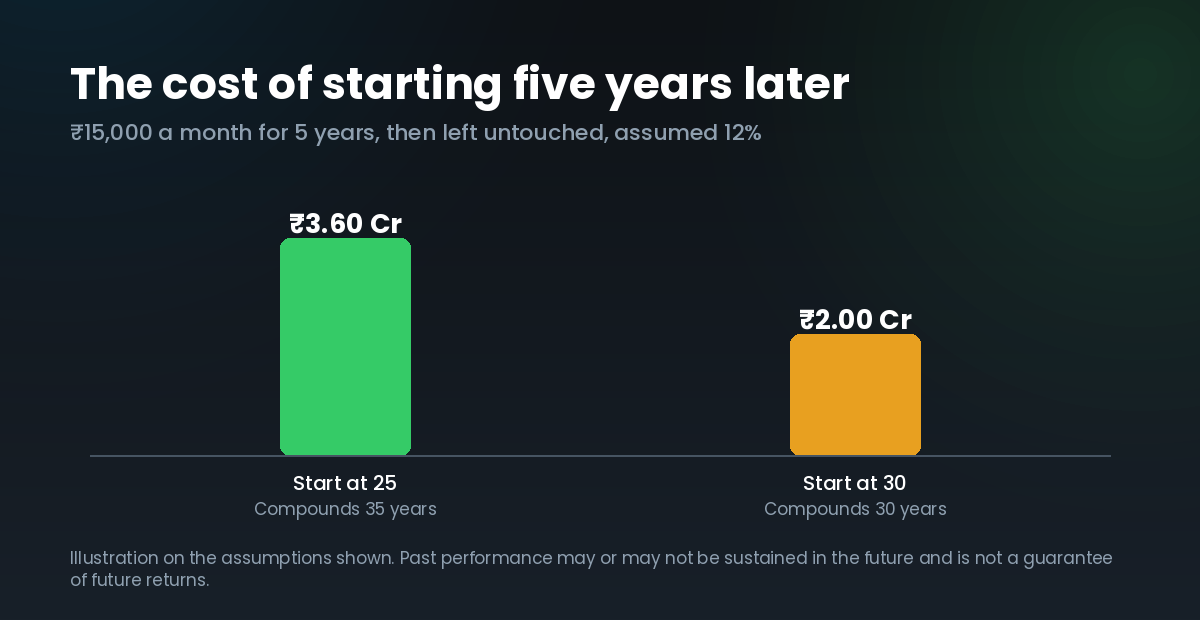
₹15,000 a month for five years, then left completely untouched for 30 more at an assumed 12%, becomes something in the region of ₹3.6 crore. The same ₹15,000 a month started five years later ends up roughly ₹2 crore. The five-year delay costs about ₹1.6 crore — not because you invested less, but because it compounded for less time.
That is what you are trading away when you direct everything at a loan. It is a real cost and it is invisible, which is why it loses arguments to a visible EMI.
Illustration at an assumed rate, for planning purposes only. Past performance may or may not be sustained in the future and is not a guarantee of future returns.
Practical points on prepaying
- Most education loans allow penalty-free prepayment. Check your sanction letter rather than assuming — some carry a charge in the first year.
- Ask what your prepayment does. A lender can either reduce your EMI or shorten your tenure. Shortening the tenure saves far more interest, and many lenders default to reducing the EMI because that is what people ask for. Specify it in writing.
- Prepaying early saves disproportionately more. The interest component of an EMI is front-loaded, so ₹1 lakh paid in year one removes far more interest than ₹1 lakh paid in year five.
- Keep the interest certificates. If you are claiming 80E you need them, and chasing a bank for a certificate three years later is a bad afternoon.
- The moratorium is not free. Interest usually accrues during study and gets capitalised. If you can pay the simple interest during the moratorium, that is often the highest-return money in the whole exercise.
What we would actually suggest
For most people finishing study and starting work: build the emergency fund first, then run both — a steady prepayment on the loan and a modest SIP alongside it.
Not because splitting is mathematically optimal. It usually is not. But it gets the loan gone in reasonable time and starts the compounding clock at the age when starting it is worth the most, and it builds the habit while the amounts are small enough to be forgiving.
You can model both sides on our calculators — the reverse EMI tool shows how much sooner the loan closes at a higher payment, and the SIP calculator shows what the same money does if invested instead. Run both. The gap between them is your actual decision.