
Most people cannot say what percentage of their income they invest. They can name their salary to the rupee and their EMI to the rupee, and the third number — the one that determines whether they ever stop working — is a vague sense that "some" goes into a SIP.
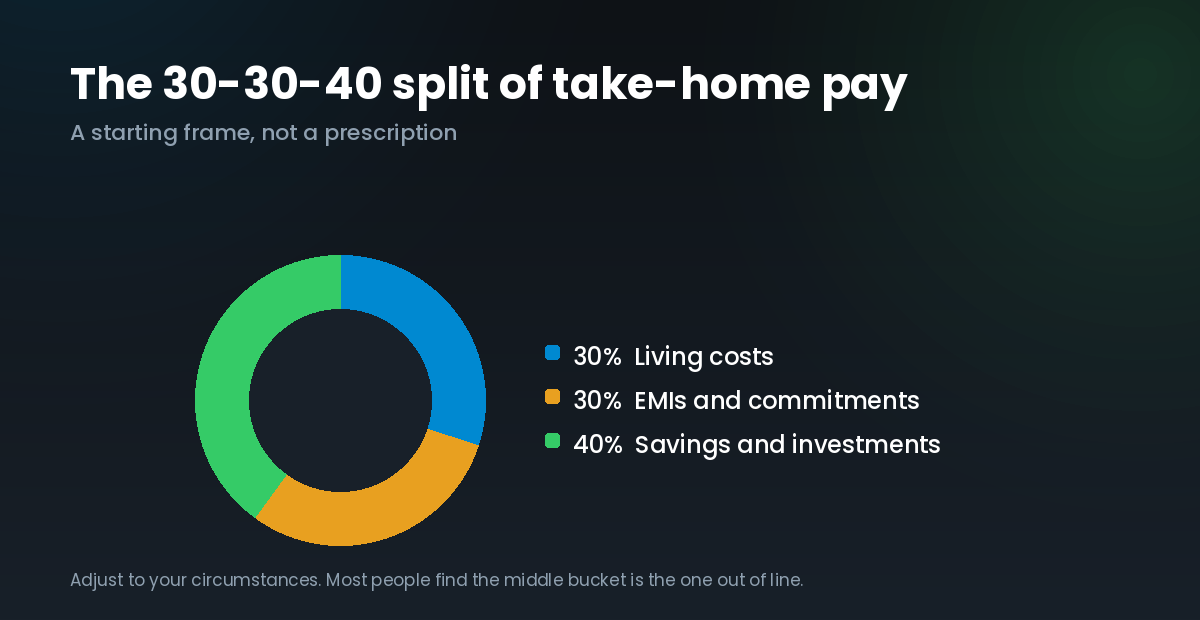
The 30-30-40 rule exists to make that number visible. It is a rough allocation of monthly take-home pay:
- 30% — living costs. Rent, groceries, utilities, transport, school fees, everything you spend to run the household.
- 30% — EMIs and fixed commitments. Home loan, car loan, insurance premiums, anything contractually owed each month.
- 40% — savings and investments. Emergency fund first, then SIPs and long-term investing.
Take your take-home pay, work out your actual three percentages, and compare. It takes five minutes and it is uncomfortable for almost everybody the first time.
Be honest: 40% is demanding
We would rather say this plainly than have you conclude you are failing at something.
Forty percent is a high bar in urban India, particularly for a single-income household in a metro paying rent. If you are at 15% and reading this, that is not a disaster and it does not mean the rule is useless to you. It means you now have a number, a direction, and a gap to close over years rather than months.
The rule's value is not in hitting it. It is in making the third figure explicit, because a percentage you have never calculated cannot be improved.
Why the middle 30 is the one that matters
Here is what the rule is really about, and it is not the living costs.
Almost everyone who fails this test fails on the EMI line. Living costs are elastic — they compress under pressure and expand with income, but you can act on them next month if you need to. An EMI cannot. It is a contract, it is fixed for years, and it has first claim on your salary before you see any of it.
Which means the middle 30% is the line that quietly sets the bottom 40%. Every rupee of EMI above 30% comes out of investing, not out of living, because living costs resist compression far harder than an investment you have not started yet.
That is the practical use of this rule: it happens before you sign, not after. A home loan is a twenty-year decision about how much you are permitted to invest for twenty years, and it is almost never framed that way at the point of signing.
The arithmetic of a slightly bigger loan
Take someone with ₹1,50,000 take-home. At 30%, their EMI ceiling is ₹45,000. Suppose they stretch to ₹60,000 for a better flat.
That extra ₹15,000 a month, invested instead over 20 years at an assumed 12%, would have compounded to roughly ₹1.50 crore.
This is not an argument against buying a house. It is an argument for knowing the second price. The flat costs the EMI, and it also costs whatever that difference would have become — and only the first number appears on any document you sign.
Illustration at an assumed rate, for planning purposes only. Not a forecast. Actual returns will differ and no return is assured.
What the 40% should contain, in order
Forty percent going somewhere is not the same as forty percent working. The order matters, and it is the same sequence we set out in why we will sometimes tell you not to invest yet:
- Emergency fund — four to six months of expenses, liquid, before anything else.
- Term and health insurance — if anyone depends on your income. A portfolio is not a substitute for a policy.
- Long-term investing — matched to specific goals with specific dates.
A common failure is counting the wrong things in this bucket. Endowment and money-back insurance policies are usually mostly premium, not investment. A recurring deposit earning less than inflation is saving rather than investing. Gold jewellery is not an investment in any useful sense once you account for making charges. Count what is actually compounding.
Adjusting the rule to your situation
Treat 30-30-40 as a starting frame, not a prescription. It shifts with circumstances:
- Early career, no dependants, sharing accommodation. You can often exceed 40%, and this is the single most valuable window you will ever have. Money invested at 25 has thirty-five years to compound; the same money at 40 has twenty. The difference is enormous and it never comes back.
- Young family, single income, city rent. Living costs alone may exceed 40%. Aim to protect a floor — even 10% — rather than chasing the target and abandoning the whole exercise.
- Business or variable income. Percentages of a number that changes monthly are hard to run. Set a fixed rupee amount based on your worst recent quarter, and treat good months as top-ups rather than raising the baseline.
- Peak earning years, loans cleared. The EMI bucket empties. If that 30% quietly becomes lifestyle instead of investment, this is where a decade of catching-up is lost. It is the most commonly wasted window after the first one.
Doing the test properly
- Take take-home pay, not CTC. CTC includes employer contributions and notional benefits you never see.
- Add up three months of bank and card statements, not one. A single month either flatters or slanders you.
- Put every outflow in exactly one of the three buckets. Ambiguity is where the exercise fails — a car loan is EMI, not living; a gym membership is living, not investing.
- Compute the three percentages.
- Look at the middle one first.
Most people find their living costs are near 30%, their EMIs are somewhere between 35% and 50%, and investing gets whatever survives — which is typically 10% to 20%, and falls in any month with an unexpected expense.
Closing the gap without a pay cut
You do not need to reach 40% next month, and trying to usually ends in reversal.
The mechanism that works is the one that costs you nothing today: raise your investing with every increment before the increment is spent. A 10% step-up on your SIP, set once as a standing instruction, moves you toward the target over years without your take-home ever falling. We covered the arithmetic in the step-up SIP, and it is the most reliable route from 15% to 40% we know of.
The other lever is the EMI line, and it is slower — refinance if rates have moved, prepay when you have a windfall, and be deliberate about the next loan rather than the current one.
The point
Financial freedom is not a product anyone can sell you. It is a percentage, sustained for long enough — the point at which what you own generates more than what you spend.
30-30-40 will not get most people there on its own. What it does is turn an invisible number into a visible one, and put attention on the EMI decision at the only moment it can still be changed.
If you want to see what your current percentage compounds to, and what a different one would, our calculators will show you both in about two minutes.