
Almost every article on this ends up as a forecast: rates are heading down, so float; rates are heading up, so fix.
Nobody knows where rates are heading, including the people writing that. A home loan runs twenty years. Predicting the rate cycle over twenty years is not analysis, it is astrology with a spreadsheet.
The useful question is different, and it has an answer.
What the two actually are
Floating rate. Your interest is tied to a benchmark — for most Indian home loans since October 2019, an external one, usually the RBI repo rate, plus a spread. When the benchmark moves, your rate moves. Lenders normally keep the EMI steady and adjust the tenure instead, so a rate rise quietly adds months or years to your loan rather than changing what leaves your account.
That last point is worth pausing on. Many borrowers believe a rate rise did not affect them because the EMI did not change. It affected them; it just did it somewhere they were not looking.
Fixed rate. Your rate is contractually locked for a stated period. In India, genuinely fixed-for-the-full-term home loans are rare. What is usually sold as "fixed" is fixed for two, three or five years and then converts to floating.
Read that clause before anything else. A loan marketed as fixed that becomes floating in year three is a floating loan with a short promotional period, and it should be evaluated as one.
The price of certainty
Fixed rates are almost always higher than floating at the point of sale — typically by somewhere between 0.5 and 2 percentage points. That gap is the premium you pay for predictability, and it is charged from day one, whether or not rates ever rise.
Which reframes the decision usefully. You are not betting on rates. You are deciding whether certainty is worth a known, immediate, guaranteed extra cost.
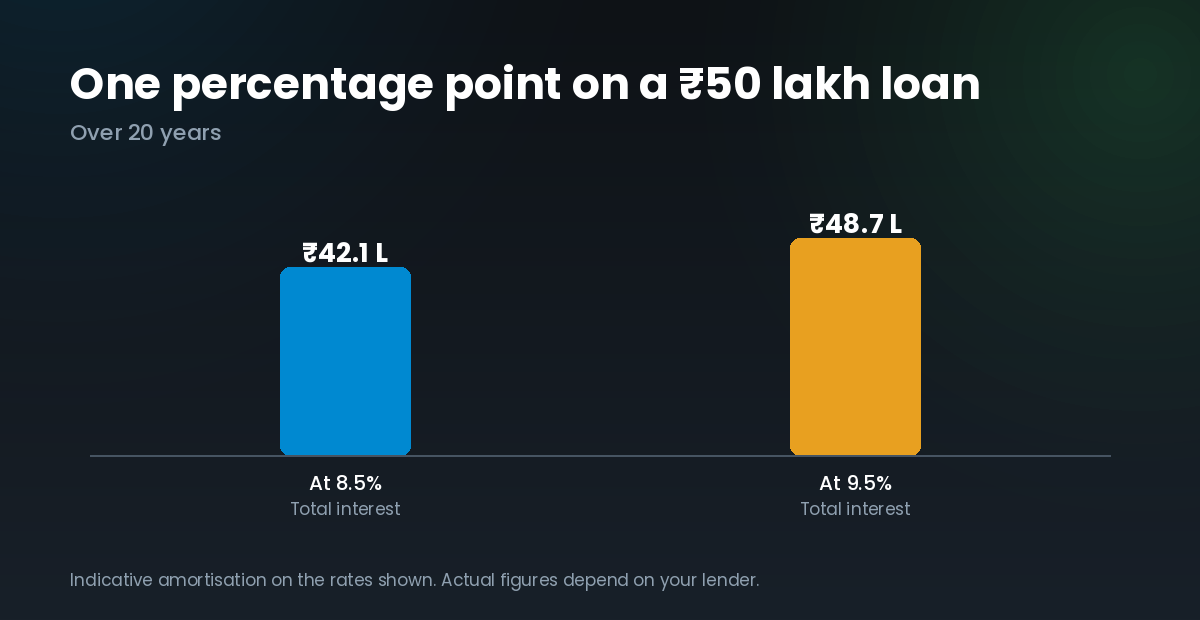
For a ₹50 lakh loan over 20 years, one percentage point is roughly ₹3,000 a month. Over the life of the loan that is around ₹7 lakh — paid with certainty, to insure against a rise that may not come.
The question that actually decides it
Not "where are rates going". This:
If my EMI rose 20% next year, what would happen to me?
If the answer is "it would be uncomfortable but fine" — float. You will pay less on average, and you can absorb the volatility.
If the answer is "I would have to cut something that matters, or borrow" — the fixed premium is buying you something real. Pay it.
This is not a question about the economy. It is a question about the gap between your income and your commitments, and only you can answer it.
Where floating usually wins
- Your EMI is comfortably inside 30% of take-home pay. You have headroom to absorb a rise. We set out why that 30% line matters in the 30-30-40 rule.
- You intend to prepay aggressively. Floating loans in India carry no prepayment penalty for individual borrowers — fixed-rate loans often do. If your plan involves annual bonuses going into the loan, a prepayment charge can wipe out the entire fixed-rate benefit.
- You may sell or refinance within a few years. Exiting a fixed loan early is usually where the charges are.
- Rates are historically high. Locking a high rate for a decade is the expensive version of caution.
Where fixed earns its premium
- The EMI is already stretching you. If a 20% rise breaks the budget, certainty is not a luxury.
- Single income, dependants, no buffer. Your capacity to absorb a shock is low; pay to remove the shock.
- Business or variable income. You already carry volatility on the earning side. Adding it on the repayment side stacks two risks that can arrive together.
- Rates are historically low and you can lock a long fix. Rare, but it is the case where fixed is unambiguously good — and it is exactly when nobody wants it.
Five things to check before you sign
- How long is "fixed"? If it converts, on what date and to what — the then-prevailing floating rate, or a stated spread? A conversion to "the prevailing rate" hands the lender the pen.
- What is the spread over the benchmark? On a floating loan the benchmark is public and the spread is yours. Two lenders on the same repo rate can differ by a percentage point. That spread is what you should negotiate, and most people never mention it.
- On a rate rise, does the EMI change or the tenure? Ask, and ask whether you can choose. A tenure that quietly extends past your retirement is a real outcome.
- Prepayment charges, in writing. Floating loans to individuals should have none. Fixed loans frequently do, and it is where the economics turn.
- The conversion fee. Most lenders let you switch from fixed to floating, or reset your floating spread, for a fee. Knowing that number now tells you how trapped you are later.
What most people should probably do
For a salaried borrower with a stable job and an EMI inside 30% of take-home: floating, with the intention to prepay whenever a bonus lands, and a diarised annual check of whether your spread is still competitive.
The prepayment freedom is worth more over twenty years than the rate certainty, and a borrower with headroom can absorb the swings.
Where we would depart from that: if you would lose sleep over it. A borrower who checks the repo rate every month and worries is not getting the benefit of the lower rate — they are paying for it in a currency that does not show up on the loan statement.
The bigger point
The fixed-versus-floating choice moves your total cost by a few percent. The size of the loan moves it by multiples.
An EMI at 40% of take-home is a worse decision than either rate structure, taken well or badly. It compresses everything you can invest for twenty years — and the choice, unlike the rate, is entirely yours at the point of signing.
Our reverse EMI calculator works backwards from what you can comfortably pay to what you could borrow. Doing it in that order, rather than falling in love with a property and reverse-engineering the affordability, is the single most useful thing on this page.