
The most common portfolio problem we see is not bad funds. It is eight funds that behave like one.
The investor feels diversified — eight names, four fund houses, a statement several pages long. And then a bad quarter arrives and every holding falls together, because they were never really different holdings.
How it happens
Nobody sets out to do this. It accumulates.
A colleague mentions something that has done well. A bank relationship manager suggests a scheme at account-opening. An article names a top performer. A new fund launches with a story attached. Each decision, in isolation, seems reasonable — and four years later you hold nine funds, feel diversified, and are not.
The mechanism is that every one of those recommendations came from the same place: recent strong performance in whatever was working at the time. Funds that have recently done well tend to hold similar things, because they did well for similar reasons.
The overlap check
This takes about twenty minutes and it is the single most useful thing you can do to a portfolio you already own.
- List every equity fund you hold. Your consolidated account statement from CAMS or KFintech gives you this across all fund houses in one document, free.
- For each, pull the top ten holdings from the latest monthly factsheet on the AMC's website.
- Put them side by side and count how many company names repeat.
If the same names appear across most of your funds, you do not have nine funds. You have one expensive fund in nine wrappers, with nine sets of paperwork.
This happens most acutely with large-cap and flexi-cap funds, which draw from a fairly limited universe of large Indian companies. Owning four of them gives you close to the same exposure four times over. It is not dangerous, exactly — but it is not doing what you think it is doing, and it costs you time and attention for nothing.
What actual diversification looks like
Diversification comes from holding things that behave differently, not from holding many things. That means spreading across:
- Asset classes — equity, debt, and possibly gold. This is by far the biggest lever. The relationship between equity and debt does more for your risk profile than any choice between two equity funds ever will.
- Market capitalisation — large, mid and small companies behave quite differently within the same year, sometimes dramatically so.
- Investment style — value and growth approaches lead in different periods, and the periods can be long enough to test anyone's patience.
- Geography, if it suits you. Though be aware international funds have their own tax treatment, which is generally less favourable than domestic equity.
Note what is not on that list: the number of funds. Most investors are adequately served by a small number of funds spanning those dimensions. Beyond a point, additional funds add administration rather than diversification.
The number that actually matters
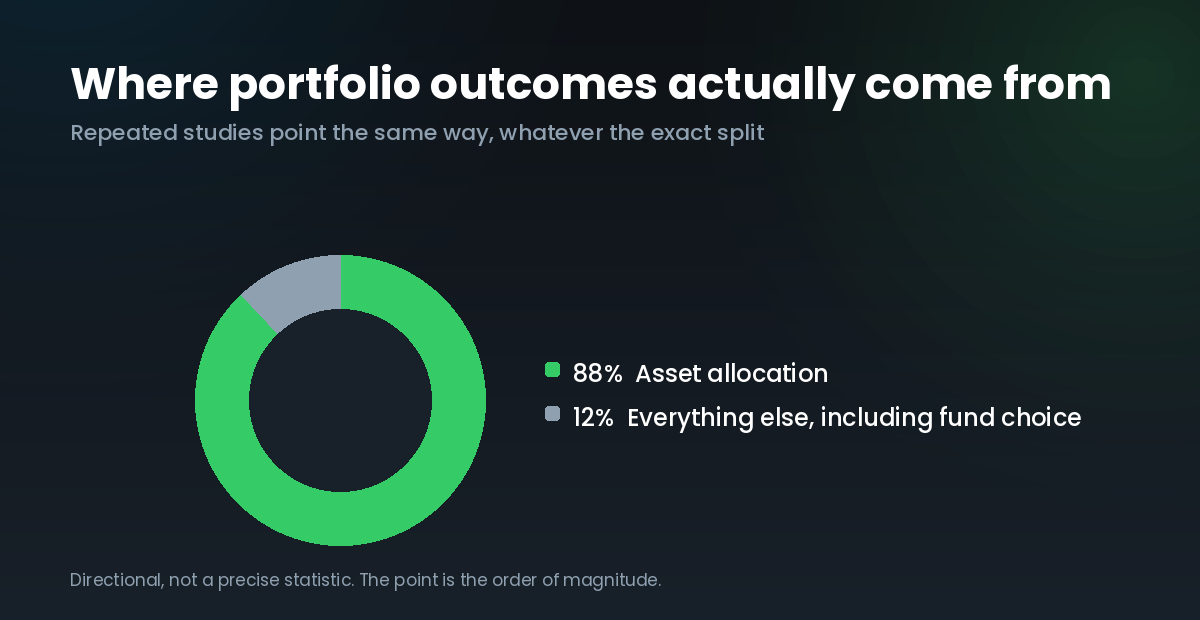
Not how many funds. Your asset allocation — the split between equity, debt and gold.
Research into what drives the variability of portfolio returns has repeatedly found that the allocation decision explains the overwhelming majority of it, and individual security or fund selection very little. That finding has been debated and refined for decades, but the direction has never seriously been in question.
Which means the hours people spend comparing two large-cap funds are being spent on the smallest lever available, while the largest one — how much is in equity at all — is often never explicitly decided. It just ended up wherever a series of unrelated purchases left it.
If you do not know your current split between equity and debt to within about ten percentage points, that is the thing to find out. Not which fund to add.
The other question worth asking
Which goal is each holding for?
If you cannot answer that for every fund you own, that is worth more attention than the overlap.
A fund without a purpose has no basis on which to be evaluated. You cannot say whether it is doing its job, because no job was ever specified. So it gets judged on recent returns instead — which is exactly the criterion that causes the problem in the first place, and the cycle continues.
Whereas a fund attached to "my daughter's undergraduate fees in 2038" can be assessed sensibly: is the allocation still appropriate for a twelve-year horizon, and is the contribution on track? Neither question is about last quarter's performance.
What to actually do about an overlapping portfolio
The instinct is to sell everything redundant and consolidate. Slow down — the cleanup can cost more than the mess.
- Redeeming is a taxable event. Equity units held over a year attract 12.5% on gains above the ₹1.25 lakh annual exemption. Tidying a portfolio can generate a real tax bill for a cosmetic improvement. See how mutual funds are taxed before you start.
- Redirect new money first. The least costly correction is to stop feeding the overlapping funds and direct fresh SIP contributions to what is genuinely missing. Over two or three years the weighting corrects itself without a single redemption.
- If you do consolidate, spread it across financial years to use the ₹1.25 lakh exemption more than once.
- Check for exit loads before redeeming anything held under a year.
A reasonable review rhythm
Once a year is enough. More often and you will start reacting to noise, which is the behaviour that costs the most.
At the annual review, four questions:
- What is my actual split across equity, debt and gold today?
- Has it drifted materially from where I intended it to be?
- Is each holding still attached to a goal, and is that goal still real?
- Has my horizon shortened enough on any goal that the allocation for it should change?
Note that "how did each fund perform?" is not on the list. It is the question everyone asks and the least informative of the five, because one year tells you almost nothing about a fund and quite a lot about which style happened to be in favour.
The point
Diversification is not a count. It is a question about correlation — do these things fall at the same time? — and the answer is not visible from the number of line items on your statement.
Twenty minutes with your factsheets will tell you more about your portfolio than a year of watching NAVs.